3D Surfaces
Properties of 3D Surfaces
Below you will find a description of some of the main properties used in a 3D rendering engine to create realistic materials and surfaces.
Diffuse
(Also called Albedo or Base Colour)
The diffuse property represents the base colour of a surface when illuminated by light. For example, if you paint a wall red, the diffuse colour of that wall is red.
Roughness
Roughness determines how rough or smooth a surface appears. A rough surface (such as sandpaper) scatters light in multiple directions, making it less shiny. A smooth surface (such as a polished mirror) reflects light uniformly, making it more shiny.
Glossiness is the opposite of roughness. A high glossiness value means that the surface is smooth and reflective, while a low value makes the surface rough and less shiny. Some rendering engines use glossiness instead of roughness, but the two properties work in opposite ways.
Metalness
Metalness specifies the metallic appearance of a surface. A high metalness value makes the surface behave like metal, reflecting most of the light and appearing shiny. A low value makes it look more like a non-metal, absorbing more light and appearing less shiny. Metalness is often used in combination with roughness to create realistic materials.
Normal
Normal Maps create the illusion of complex details, such as bumps or dents, without adding additional geometry. They store directional information for the surface in the RGB colour channels, creating an appearance of depth and texture.
It is also possible to give the illusion of relief with a greyscale image, where white represents the maximum (1) and black the minimum (0). In this case, we refer to a Bump Map. However, bump maps are less detailed than normal maps, as they only give direction values on a single axis.
Displacement
Displacement changes the actual shape of the surface, adding three-dimensional details such as bumps, wrinkles or cracks. Unlike normal maps, displacement maps physically alter the geometry of the surface.
Transmission
Transmission controls the amount of light that passes through a material, such as glass or water. Higher transmission values make the material more transparent.
Emission
Emission causes a surface to emit its own light. For example, a light bulb or incandescent metal would have an emission value, causing it to appear as a light source.
Subsurface Scattering
Subsurface Scattering simulates the penetration of light into a surface, its dispersion within the material, and its exit at another point. This property is essential for materials such as skin, marble, milk or wax, giving them a realistic appearance.
Ambient Occlusion
Ambient occlusion adds shading to areas where less light would naturally reach, such as corners and crevices. This helps to create a sense of depth and realism in the scene.
Index of Refraction
The index of refraction defines the amount of deviation of light when it enters a material. Different materials, such as glass, water, or diamond, have unique IORs, which explains their different appearances. Adjusting IOR values can make a material appear like glass, crystal, or any transparent substance.
Lambertian Diffusion
Lambertian diffusion describes a type of light diffusion on matt surfaces. When light strikes such a surface, it diffuses evenly in all directions, making it appear uniformly lit from all angles. This effect is named after Johann Heinrich Lambert, who described this behaviour.
Sampling
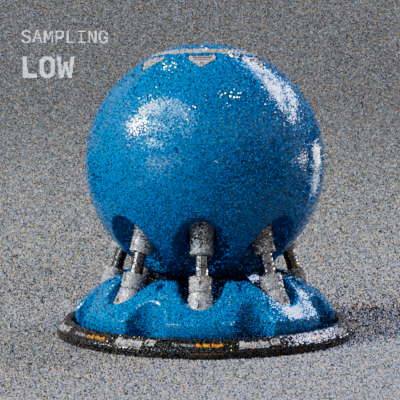
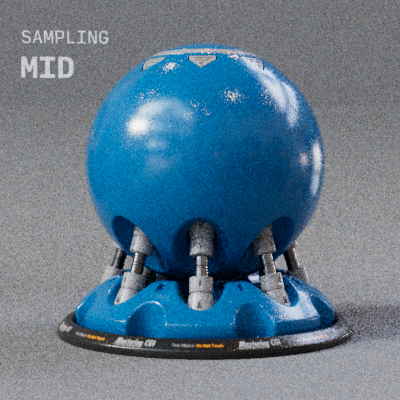
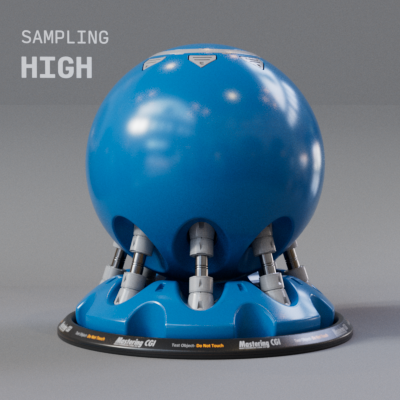
In 3D rendering, sampling is the process of calculating multiple rays of light for each pixel in order to achieve realistic lighting, shading and shadows. The more samples there are, the smoother and more detailed the rendered image will be, but this increases the rendering time, requiring a balance between quality and speed.
BSDF
BSDF (Bidirectional Scattering Distribution Function) describes how light interacts with a surface, covering both reflection and transmission (light passing through the surface). It combines reflection (BRDF) and transmission (BTDF) models to define the scattering of light in all directions on or through a material.
BRDF
BRDF (Bidirectional Reflectance Distribution Function) is a specific type of BSDF that focuses on reflection. It defines how light is reflected off a surface at different angles, helping to simulate the shiny, matte, or satin appearance of a material.
BTDF
BTDF (Bidirectional Transmittance Distribution Function) is a function that describes how light passes through a material and emerges on the other side. It defines the transmission of light in different directions, simulating realistic effects for materials such as glass, water or frosted surfaces. Combined with BRDF, it fully describes how light interacts with a surface.